In acute myeloid leukemia (AML), the proliferation of leukemic cells is accompanied by a profound alteration of the bone marrow microenvironment, which promotes disease progression. Among the key players in this microenvironment are
bone morphogenetic proteins* (BMPs), which regulate cell differentiation and adhesion by interacting with their receptors (ALK*) and
integrins*. However, their effects on mesenchymal stem cells (MSCs), which are essential for maintaining the bone marrow, remain poorly understood, even though their differentiation capacity is impaired in AML.
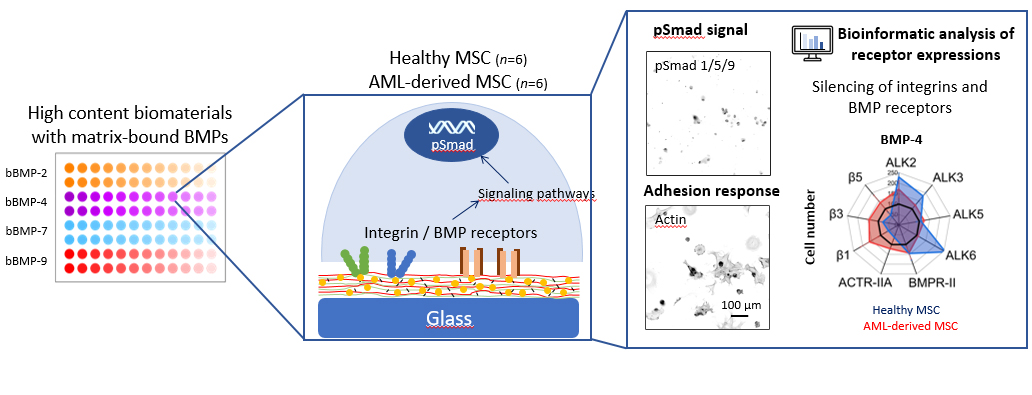
In this study, the researchers worked to understand how CSMs adapt to a leukemic microenvironment enriched with BMPs. To replicate this environment, they developed a biomimetic matrix containing various cytokines from the TGF-β superfamily, notably BMPs (BMP-2, BMP-4, BMP-7, BMP-9) and TGF-β1. By comparing CSMs from healthy donors with those from leukemic patients, they analyzed the activation of a signal transduction pathway, cell adhesion and spreading. They also studied the CSMs ability to differentiate into bone, cartilage, and fat cells. They identified three main abnormalities: excessive and persistent activation of the signaling pathway, impaired cell adhesion, and a reduced ability to differentiate. The researchers determined that these abnormalities were due to a dysfunction in the interactions between the ALK5 receptor and integrins.

© CEA-Irig/BioSanté – Adaptated from I. Arnaldos Perez thesis (2025)
Figure : A biomimetic material on a 96-well plate that detects alterations in the MSCs of leukemic patients in the
pSmad signaling pathway*, cell adhesion, and differentiation, thereby highlighting the specific role of BMP receptors and β-integrins (adhesion receptors).
pSmad signaling pathway*: intracellular signaling pathway activated by proteins of the TGF-β superfamily (including BMPs), which regulates the expression of numerous genes involved in cell development, differentiation, and function.
The ALK5 receptor, which is already involved in several types of cancer, appears to be a promising therapeutic target in AML. ALK5 inhibitors, currently being developed for other cancers, could therefore be evaluated for the treatment of AML disease. Furthermore, the biomimetic material developed and used in this study—which replicates in a simplified manner the microenvironment of human bone marrow—provides a new tool for identifying novel therapeutic targets, evaluating existing treatments, and developing preclinical models that more accurately represent leukemia.
Mesenchymal stem cells* (MSCs): adult stem cells found primarily in bone marrow, capable of differentiating into several cell types, including bone, cartilage, and fat cells. They secrete numerous growth factors,
cytokines*, and extracellular matrix proteins that promote blood cell renewal, tissue repair, and modulation of the immune response. They thus play an essential role in maintaining the bone marrow microenvironment.
Bone morphogenetic proteins*(BMPs): signaling molecules belonging to the TGF-β (Transforming Growth Factor-β)
cytokine* superfamily, which regulate cell development and differentiation, particularly in bone tissue.
cytokines*: signaling proteins that enable cells to communicate with one another and play an essential role in regulating immune responses, inflammation, and cell growth.
ALK* (Activin Receptor-Like Kinases): Type I membrane receptors that transmit signals from cytokines of the TGF-β superfamily (including BMPs), thereby regulating cell proliferation, differentiation, and adhesion. ALK5 is the primary receptor for TGF-β1, but it may also be involved in signaling for certain BMPs (notably BMP-2, BMP-4, BMP-7, and BMP-9).
integrins*: membrane proteins located on the surface of cells that enable them to adhere to their environment (extracellular matrix). They also transmit signals that influence cell behavior (growth, migration, survival, differentiation).
UMR : Université Grenoble Alpes (UGA), INSERM, CEA, CNRS -
Irig/Biosanté.
Collaborations : Centre de Recherche en Cancérologie de Lyon (CRCL), Institute for Advanced Biosciences (IAB).
Fundings : ERC (BioactiveCoatings GA692924), MSD Avenir, INCa, Région AuRA.